
Al Mansouri Al Kebir
Description
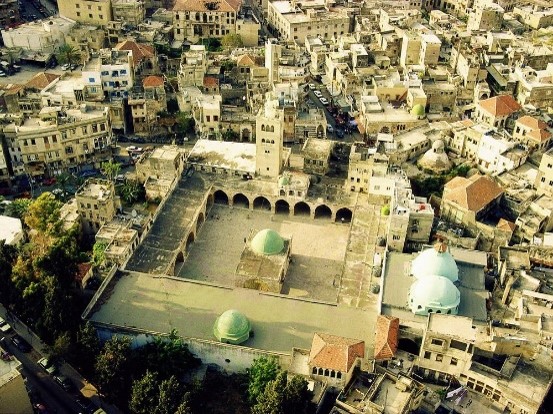
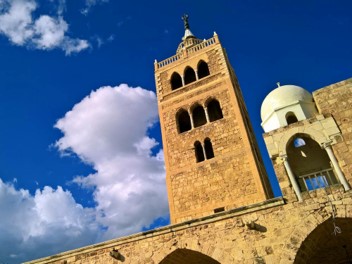
Its name refers to the Sultan Kalawoun The Victorious ( Al Mansour), who was a Mamluk hero who liberated Tripoli from the Crusaders. Built in the heart of the ancient city, under the Citadel, the Mosque has a Gothic Portal and Minaret, some remains of the Crusader Church of St Mary of the Tower. The Bell house, a Lombardian style, was turned to a Mamluk squarish Minaret, topped by a circular higher part. The Minaret owes to the European Middle-ages the 3 arched windows symbolizing the Trinity, and flanked by the columns, in the second and third floor. The small vaulted room giving on the exterior arched courtyard of the mosque, has a plaque representing the solar clock. The Mamluks were keen to fix the 5 daily prayers time and the Ramadan rituals, having brought from Cairo the sheikhs in charge of this religious mission. On the top pf the entrance gate one can see the information stating who commissioned the construction of the mosque under the governor of Tripoli Ezzedine Aybak. They added as well the name of the Architect Salem the Jewish, son of Nasser the Persian, May God Forgive him…
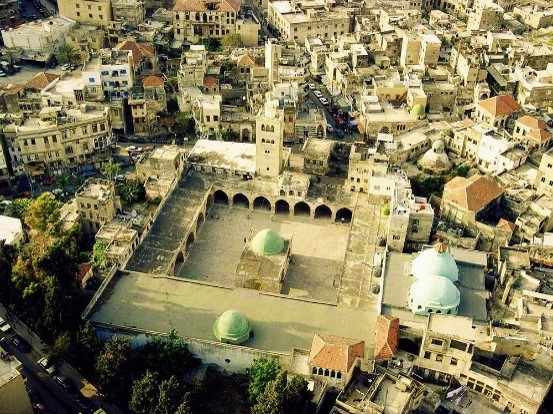
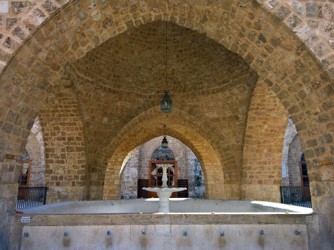
Facing the portal, you can see the marble fountain for the ablution in the middle, topped by a dome, surrounded by arched corridors. The 2 parts of the granite columns in the courtyard go back to the Roman legacy, in addition to some ornamentation left from the Crusaders. Another plaque inside adds new information related to the architectural structure.
The Mihrab sided by 2 columns, is ornamented with arabesque and the Minbar inside the prayer room has been renovated after the fire. Some ornamentation recalls the crusader style, and became actually a main feature of the Mamluk style (the Zigzag). As most of the mosques, Al Mansouri has more than 2 doors in order to facilitate joining the prayers from the different souks around. The Mosque is surrounded by 4 Islamic Schools where the children and students use to learn reading, writing and Islamic studies.
An internal staircase leads to the upper floor of a spacious hall with eight deep hollows in walls, and the tower harmoniously incorporates diverse architectural and decorative elements. The tower is often used as an archaeological heritage site for public ceremonial events
The fountain in the courtyard
The Minaret is a remain of a house bell.
The Mansouri Great Mosque in Tripoli, Lebanon, is an example of a composite architectural style that combines elements of various historical periods and cultural influences: Roman Columns, crusader entrance gate and minaret, Mamluk architecture, the upper part of the minaret is Ottoman with a cylindric, and conic form.